The problem in brief
Comic-book heroes from many universes have been merged into a single table: one row per character, with descriptive traits (publisher, gender, race, eye and hair colour, height, weight, alignment), about 80 yes/no abilities (Flight, Agility, Telepathy...) and numerical "power stats" (intelligence, strength, speed, durability, power, combat). There are 505 heroes in train.csv and 100 in test.csv. Two warm-up questions ask for simple statistics on the training table, then two modelling tasks: predict each test hero's combat stat (regression) and whether they have Super Strength (binary classification).
How you are scored
100 points in four parts:
| task | what | scoring |
|---|---|---|
| 1 | number of distinct Publisher values in train | exact answer, 10 points |
| 2 | publisher with the most Alignment = good heroes (ties: alphabetical) | exact answer, 10 points |
| 3 | powerstats__combat for each test hero | MAE, 40 points |
| 4 | Super Strength (0 or 1) for each test hero | accuracy, 40 points |
For task 3, with :
so MAE earns the full 40 points. For task 4, clipped to , so accuracy is the full-score line (statement, "Evaluation"). Test labels are private: the scores below are 5-fold cross-validation on the training set.
Tasks 1 and 2: the warm-up
Both are one line of pandas, as long as you read the question literally.
tr["Publisher"].nunique()gives 23. No value is missing in this column, so there is no "should NaN count?" ambiguity. Marvel (276) and DC (141) dominate; eight publishers appear only once.- Among the 323 heroes with
Alignment == "good",value_counts()gives Marvel Comics 172, DC Comics 87, NBC - Heroes 12. No tie, so the answer is Marvel Comics. Careful: 25 heroes have a missing alignment and 5 have the value "-": they are simply not "good".
First look at the data
The interesting discovery is in the power stats. Plot a histogram of any of them, say intelligence:
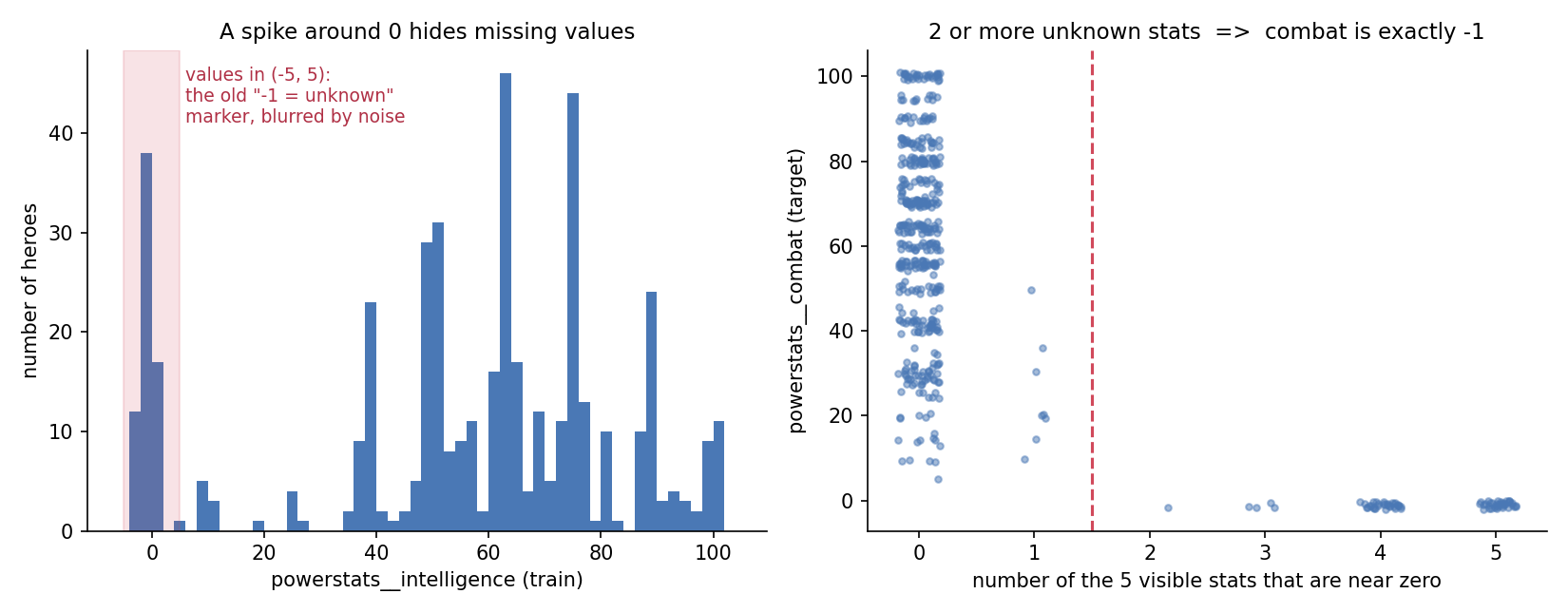
Real values live between about 5 and 100 (with a few noisy values above 100, up to 250 for strength), but about 15 % of each stat sits in a narrow cloud around 0, with negative values like or . A stat of makes no sense. The explanation: in the public superhero database this table comes from, an unknown stat is written as . The organisers added a little random noise to the five visible stats, which turned the clean marker into a fuzzy cloud in . The target column powerstats__combat was left clean: it contains exactly for 72 heroes (14 %).
And the stats of a hero tend to be unknown together. Counting, for each hero, how many of the five visible stats fall in :
| near-zero visible stats | 0 | 1 | 2 | 3 | 4 | 5 |
|---|---|---|---|---|---|---|
| heroes with combat | 0 | 0 | 1 | 4 | 31 | 36 |
| heroes with a real combat | 425 | 8 | 0 | 0 | 0 | 0 |
The rule "2 or more unknown stats combat " is exact on all 505 training heroes. In the test set, 17 heroes satisfy it.
Two other observations: the extra columns meta_score, efficiency_delta and stability_index look synthetic (correlation with combat , flat averages across the A to D categories), and Super Strength is strongly tied to the strength stat (84 % to 100 % of heroes with strength above 20 have it, only 14 % of those between 5 and 20).
A first baseline
Task 3: predicting the median combat (60) for everybody gives MAE 24.9, which is worth only 11 of 40 points. Simply applying the rule above (predict for the 72 "unknown" heroes, the median of the others for the rest) already drops the MAE to 16.0.
Task 4: the majority class (Super Strength , 55 %) gives accuracy 0.550, i.e. 0 points. A random forest on all columns gives 0.873.
The key idea
A missing-value marker is information, not a number. The convention, made fuzzy by noise, is the single most important structure in this dataset. It matters in two ways.
- For the target. Absolute error is unforgiving for this group: if a model predicts 50 for a hero whose combat is , it pays 51 points of error on that hero. With 14 % of such heroes, getting them wrong costs about points of MAE, more than the whole gap between a mediocre and a perfect model on the others. Since the rule is exact, we hard-code it: those heroes receive exactly and cost zero.
- For the features. A stat of that really means "unknown" must not be read as "very weak". We replace every visible stat in by NaN (later filled with the median of known values), clip the remaining values to , and add the count of unknown stats as a feature. A model then learns from real stats only. We also train the combat regressors only on the 433 heroes whose combat is known: mixing the heroes into the training set would drag the regression towards for anybody with weak-looking stats.
Why does a tree model not discover all this alone? A tree could in principle split on "intelligence ", but it must learn the same pattern separately from noisy columns with only 505 rows, and a squared-error regressor still averages heroes with real ones in mixed leaves. Encoding the domain knowledge explicitly is cheaper and exact.
The full solution
Features (shared by tasks 3 and 4): the five visible stats cleaned as above, the number of unknown stats, the ~80 binary abilities, the number of abilities, height, weight, indicators for the most frequent races (Human, Mutant, God / Eternal, Human / Radiation, Android, Alien, Cyborg, "-").
Task 3: for heroes with 2 or more unknown stats, predict . For the others, average three regressors trained on the heroes with known combat: a random forest (500 trees, min_samples_leaf=3, max_features=0.3), extra trees, and a Huber regression on standardised features (robust to outliers, which suits an MAE metric). The trees capture interactions (combat is high for "Peak Human Condition", "Weapons Master" or "Marksmanship" heroes: +25 to +30 on average), the linear model the smooth link with intelligence (correlation 0.71).
Task 4: a random forest (800 trees, max_features=0.3) on the same features, without the synthetic columns and the publisher, gender and alignment indicators, which only added noise.
unknown = d[STATS].abs() < 5                 # the noisy "-1 = unknown" marker
X["n_unknown_stats"] = unknown.sum(axis=1)
for s in STATS:
    X[s] = d[s].where(~unknown[s]).clip(0, 100)
...
pred = np.where(n_unknown >= 2, -1, np.mean([rf, et, huber], axis=0))
Results
5-fold cross-validation on the 505 training heroes (repeated 3 to 4 times with different splits for the final lines). Points use the official formulas.
| task 3: combat | MAE | points / 40 |
|---|---|---|
| constant median | 24.94 | 11.2 |
| rule () + median of the others | 16.02 | 31.1 |
| HistGradientBoosting (absolute loss), no rule | 13.15 | 37.4 |
| rule + HistGradientBoosting (absolute loss) | 13.05 | 37.7 |
| rule + random forest | 12.63 to 12.81 | 38.2 to 38.6 |
| rule + Huber regression | 13.02 | 37.7 |
| rule + random forest using the median of the trees | 12.75 | 38.3 |
| rule + mean of random forest, extra trees, Huber (final) | 12.59 | 38.7 |
| task 4: Super Strength | accuracy | points / 40 |
|---|---|---|
| majority class | 0.550 | 0 |
| logistic regression | 0.826 | 31.5 |
| extra trees | 0.857 | 35.1 |
| random forest, all columns | 0.873 to 0.885 | 36.9 to 38.3 |
| HistGradientBoosting | 0.882 | 37.9 |
| random forest without synthetic/meta columns (final) | 0.890 | 38.9 |
With tasks 1 and 2 correct, the expected total is about out of 100. With 505 rows the standard error is about 0.4 MAE and 0.014 accuracy, so differences of a few tenths between models in the tables are not significant.
What did not work: adding race indicators and the ability count did not change the combat MAE; blending the classifiers (random forest + logistic regression) made task 4 worse (0.855), because the logistic regression is clearly weaker and drags the average; tuning max_features moved accuracy by less than 0.01. Errors in task 4 are concentrated on heroes with unknown stats (22 % error rate versus 10 % for the others): without a strength value, the model only has the ability list to go on.
What to remember
- Always histogram your columns. A spike in an impossible place (negative stats here) is usually a sentinel value for "missing", possibly disguised by noise.
- Sentinels must be decoded, not modelled. Turn them into NaN plus a "was missing" indicator, and when the target itself has a sentinel, look for a deterministic rule that predicts it before training anything.
- Know what your metric punishes. Under MAE, a handful of grossly wrong predictions (50 instead of ) costs more than small errors everywhere; under accuracy, a constant prediction is worth zero points here.
- Train on the population you will predict. The combat regressors learn only from heroes with a real combat value, because the others are handled by the rule.
- Remove noise columns when the dataset is small: dropping the synthetic columns gained about 0.01 accuracy.