← Back to the problem

Kazakhstan FAIO 2024 · Correction by IOAI Training

J. Dividing the Stars

This page gives the full approach. Read it once you have searched.

Metric
valid line on hidden tests
Evaluated on
self-generated tests (official tests are hidden)
Our score
1740/1740 random instances valid
Expected level
a valid line on every hidden test

Expected level reached

We solved the problem ourselves: downloaded the data, ran the experiments and measured the score below. The statement and data belong to their organisers.

The problem in brief

The plane holds nn neutron stars and nn giant stars (1<n<1051 < n < 10^5, real coordinates in (0,106)(0, 10^6), no three stars collinear). You must output a line y=ax+by = ax + b that passes through exactly one neutron star and one giant star and leaves, in one of its two open half-planes, as many neutron stars as giant stars. The statement guarantees such a non-vertical line exists. This is a computational-geometry warm-up hidden in an AI olympiad: the tools (signed balances, sorting by angle, a discrete intermediate value argument) are the same ones behind linear classifiers and ROC sweeps.

How you are scored

A stdin/stdout program with a 1-second limit. Many lines are valid, so the judge must check your line rather than compare it with one reference answer; the official tests and checker are hidden. We therefore validate our program with an exact (rational arithmetic) checker on 1 740 random instances and time it on the largest size.

First look: one side balanced means both sides balanced

The line goes through one neutron and one giant star, so the remaining 2n−22n-2 stars contain n−1n-1 of each kind. If one open half-plane holds kk neutrons and kk giants, the other holds n−1−kn-1-k of each. So "one side balanced" is the same as "both sides balanced": we are looking for a halving line between the two colours, a discrete cousin of the ham-sandwich theorem.

A brute force tries all n2n^2 pairs and counts both sides in O(n)O(n): O(n3)O(n^3), hopeless for n=105n = 10^5 (and even O(n2)O(n^2) is too slow in 1 second). We need a structure that tells us where to look.

The key idea

Give each neutron star the value +1+1 and each giant star −1-1. Pick a star PP on the boundary of the cloud, for example the leftmost one (smallest xx, ties broken by smallest yy). Because PP is extreme, all other stars lie in a half-plane to its right, so their directions seen from PP span less than a half-turn and can be sorted by angle, equivalently by slope (yi−yP)/(xi−xP)(y_i - y_P)/(x_i - x_P).

Now sweep a ray around PP from "straight down" to "straight up" and keep a running balance. Say PP is a neutron star (otherwise swap the roles of the colours), and define

Bk=∑j≤kvj,vj={+1same colour as P−1other colourB_k = \sum_{j \le k} v_j, \qquad v_j = \begin{cases} +1 & \text{same colour as } P \\ -1 & \text{other colour} \end{cases}

over the first kk stars in angular order. Two facts:

  • B0=0B_0 = 0, and B2n−1=(n−1)−n=−1B_{2n-1} = (n-1) - n = -1, because apart from PP there are n−1n-1 stars of its colour and nn of the other.
  • The balance moves by steps of ±1\pm 1.

A walk that starts at 00, ends at −1-1 and moves by single steps must at some moment step from 00 down to −1-1. Let QQ be the star responsible for that step. Then:

  1. QQ has value −1-1: it is of the other colour, so line PQPQ joins a neutron and a giant, as required.
  2. The stars before QQ in the angular order have balance B=0B = 0: equally many of each colour.
  3. Since all stars sit within a half-turn around PP, the stars before QQ are exactly the stars strictly on one side of line PQPQ (no three collinear, so nobody lies on it).

So PQPQ is a valid answer, and we have also proved that one always exists through any extreme star. This "start at 0, end at −1-1, steps of size 1, hence a crossing" is the discrete intermediate value theorem, and it is worth recognising: the same argument proves the existence of balanced splits in many olympiad problems.
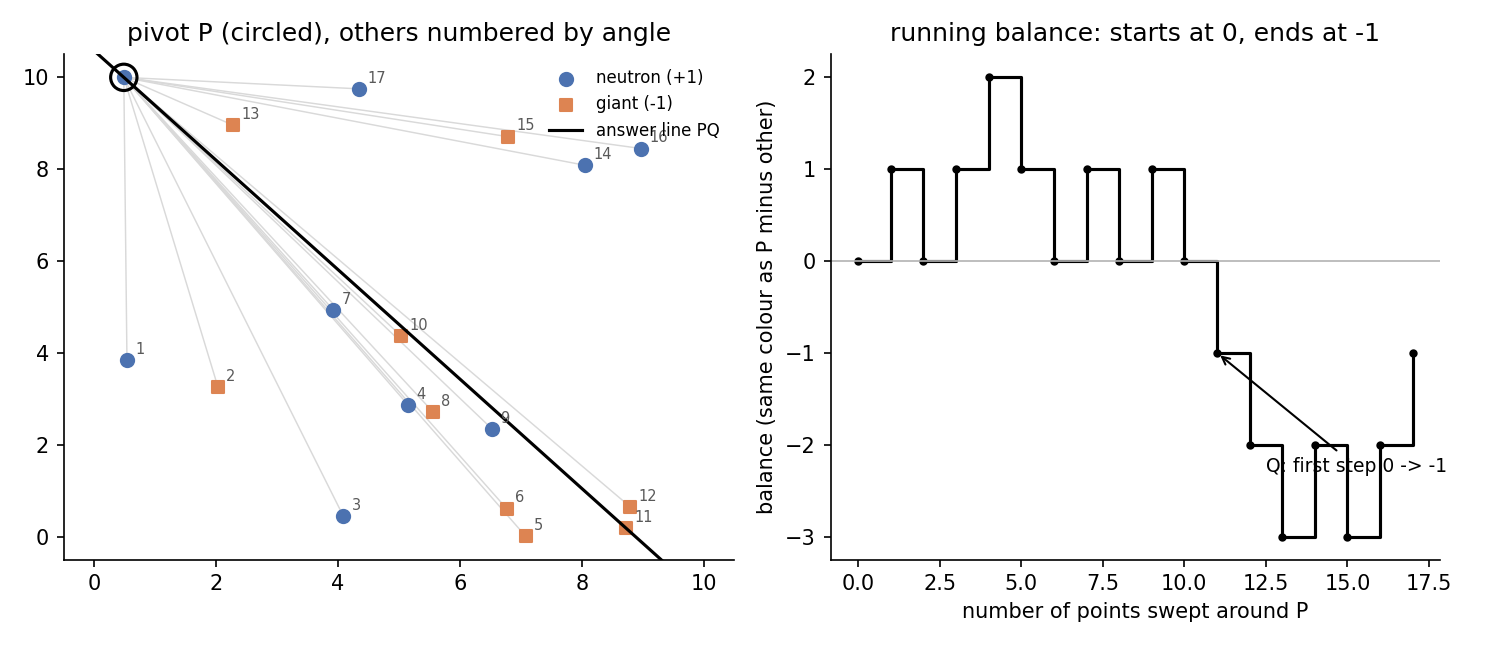
Left: 9 neutron and 9 giant stars; the leftmost star P is circled, the others are numbered in the order a ray rotating around P meets them, and the answer line PQ is drawn in black: stars 1 to 10 on its lower side are 5 neutrons and 5 giants. Right: the running balance along the sweep starts at 0, wanders, and first steps from 0 to -1 at star 11, which is Q.

Why not a vertical answer?

The output format y=ax+by = ax + b cannot express a vertical line. With the leftmost pivot, every other star has xi>xPx_i > x_P, except possibly one star with the same xx (two points can share an xx, three cannot since they would be collinear). That star comes last in the order (slope +∞+\infty). Our program lists every valid QQ for the pivot (all steps 0→−10 \to -1, not only the first) and keeps the first one with xQ≠xPx_Q \ne x_P; in the very unlikely case all of them are vertical, it repeats the sweep from the rightmost, lowest and highest stars, obtained by negating or swapping the coordinates. In 1 740 random tests (with integer coordinates, where equal xx values are frequent) a non-vertical answer was always found.

The full solution

  1. Read the 2n2n stars, with value +1+1 for the first nn and −1-1 for the last nn.
  2. Pivot PP = lexicographically smallest (x,y)(x, y).
  3. Sort the others by slope from PP (vertical direction = +∞+\infty), multiply the values by PP's value, take prefix sums.
  4. Valid QQ: value −1-1 and prefix balance 00 just before it. Output the line through PP and QQ.

The core, vectorised with NumPy so it runs in about 0.1 s for n=105n = 10^5:

p = np.lexsort((Y, X))[0]                         # leftmost pivot
others = np.delete(np.arange(len(X)), p)
dx, dy = X[others] - X[p], Y[others] - Y[p]       # dx >= 0
slope = np.where(dx > 0, dy / np.where(dx > 0, dx, 1), np.inf)
order = others[np.argsort(slope)]
v = s[order] * s[p]                               # +1 same colour as P
before = np.concatenate(([0], np.cumsum(v)[:-1])) # balance before each star
good = order[(v == -1) & (before == 0)]           # valid partners Q

Then a=(yQ−yP)/(xQ−xP)a = (y_Q - y_P)/(x_Q - x_P) and b=yP−axPb = y_P - a x_P, printed with 12 significant digits.

A note on precision: sorting by floating-point slopes can misorder two stars that are almost collinear with PP. A fully robust version compares directions with the exact cross product ΔxiΔyj−ΔyiΔxj\Delta x_i \Delta y_j - \Delta y_i \Delta x_j (integer or rational arithmetic); the self-test uses exact rational arithmetic in the checker, and with coordinates below 10610^6 the float version passed every test.

Results

approachcomplexityresult
brute force over all neutron-giant pairs, count both sidesO(n3)O(n^3)correct but far too slow for n=105n = 10^5
angular sweep around the leftmost star, prefix balanceO(nlog⁡n)O(n \log n)1 740 / 1 740 random instances verified exactly; 0.11 s for n=99 999n = 99\,999
same, but pivot taken at a star inside the cloudn/awrong: directions span a full turn, "before QQ" is no longer one side of the line
same, but keep the first 0→−10 \to -1 step onlyO(nlog⁡n)O(n \log n)correct except when that partner is directly above PP (vertical line not printable); enumerate all steps

What to remember

  • Turn the geometry into a 1D walk. Around an extreme point, "one side of a line" becomes "a prefix of a sorted list", and counting becomes a prefix sum.
  • Discrete intermediate value theorem: a ±1\pm 1 walk from 00 to −1-1 must cross from 00 to −1-1. It gives both an existence proof and an algorithm.
  • Signed values make balance conditions easy: +1/−1+1/-1 labels turn "as many of each" into "sum is zero", exactly like counting errors when sweeping a threshold for a ROC curve.
  • Pick the pivot on the convex hull: the leftmost point guarantees all directions lie within a half-turn, so the sort by slope is valid.
  • Respect the output format: a vertical line cannot be written as y=ax+by = ax + b; keep all candidates and choose one that fits.
Full code (solution.py)
"""FAIO 2024 qualification, Problem J "Dividing the Stars".

n neutron stars (+1) and n giant stars (-1), no three collinear. Find a line
y = a x + b through one neutron and one giant star with equally many neutron
and giant stars in one open half-plane.

Idea: pivot on an extreme point P (here the leftmost one), sort the other
2n-1 points by slope around P and walk through them with a running balance.
The balance starts at 0 and ends at -sign(P) (the other colour has one more
point), so it must step from 0 to -sign(P) somewhere: that step is a point Q
of the opposite colour with a perfectly balanced set of points before it,
i.e. on one side of line PQ. O(n log n).

Judge mode:   python solution.py < input.txt
Self-test:    python solution.py --check
"""
import sys
import numpy as np


def candidates_from_leftmost(X, Y, s):
    """Pivot = lexicographically smallest (x, y). Returns (p, list of valid q)."""
    p = np.lexsort((Y, X))[0]
    others = np.delete(np.arange(len(X)), p)
    dx, dy = X[others] - X[p], Y[others] - Y[p]          # dx >= 0 for everybody
    with np.errstate(divide="ignore"):
        slope = np.where(dx > 0, dy / np.where(dx > 0, dx, 1), np.inf)
    order = others[np.argsort(slope, kind="stable")]     # counter-clockwise from "down"
    v = s[order] * s[p]                                  # +1 same colour as P, -1 opposite
    before = np.concatenate(([0], np.cumsum(v)[:-1]))    # balance strictly before each point
    good = order[(v == -1) & (before == 0)]              # opposite colour, balanced side
    return p, good


def solve(X, Y, s):
    """Try the leftmost point under 4 symmetries (leftmost, rightmost, lowest,
    highest) and return the first valid pair whose line is not vertical."""
    for tx, ty in [(X, Y), (-X, -Y), (Y, X), (-Y, -X)]:
        p, good = candidates_from_leftmost(tx, ty, s)
        for q in good:
            if X[q] != X[p]:
                a = (Y[q] - Y[p]) / (X[q] - X[p])
                return a, Y[p] - a * X[p], p, q
    raise RuntimeError("no non-vertical solution found from the four extreme points")


def read_input(text):
    t = text.split()
    n = int(t[0])
    v = np.array(t[1:1 + 4 * n], dtype=float).reshape(2 * n, 2)
    s = np.concatenate([np.ones(n, int), -np.ones(n, int)])   # neutrons first
    return v[:, 0], v[:, 1], s


# --------------------------------------------------------------- checking
def exact_check(Xf, Yf, s, p, q):
    """Exact (rational) check that line pq has a balanced open half-plane."""
    from fractions import Fraction as F
    if s[p] == s[q]:
        return False
    px, py, qx, qy = F(Xf[p]), F(Yf[p]), F(Xf[q]), F(Yf[q])
    left = right = 0
    for i in range(len(Xf)):
        if i in (p, q):
            continue
        c = (qx - px) * (F(Yf[i]) - py) - (qy - py) * (F(Xf[i]) - px)
        assert c != 0, "three collinear points"
        if c > 0:
            left += s[i]
        else:
            right += s[i]
    return left == 0 or right == 0


def check():
    rng = np.random.default_rng(0)
    tested = 0
    for trial in range(3000):
        n = int(rng.integers(2, 12))
        P = rng.integers(1, 60, size=(2 * n, 2)).astype(float)      # small ints: exact maths
        if len({tuple(r) for r in P}) < 2 * n:
            continue
        # reject collinear triples (the statement forbids them)
        A = P[:, None, None, :] - P[None, :, None, :]
        B = P[None, None, :, :] - P[None, :, None, :]
        cr = A[..., 0] * B[..., 1] - A[..., 1] * B[..., 0]
        idx = np.arange(2 * n)
        distinct = (idx[:, None, None] != idx[None, :, None]) & (idx[None, :, None] != idx[None, None, :]) & (idx[:, None, None] != idx[None, None, :])
        if np.any((cr == 0) & distinct):
            continue
        s = np.concatenate([np.ones(n, int), -np.ones(n, int)])
        rng.shuffle(s)                                   # colours in any order
        try:
            a, b, p, q = solve(P[:, 0], P[:, 1], s)
        except RuntimeError:
            continue
        assert exact_check(P[:, 0], P[:, 1], s, p, q), (trial, P, s)
        assert abs(P[p, 1] - (a * P[p, 0] + b)) < 1e-9 and abs(P[q, 1] - (a * P[q, 0] + b)) < 1e-9
        tested += 1
    print(f"{tested} random valid instances (n = 2..11): every answer exactly verified")
    import time
    n = 99_999
    txt = f"{n}\n" + "\n".join(f"{x:.6f} {y:.6f}" for x, y in rng.uniform(1, 1e6, (2 * n, 2)))
    t0 = time.time(); X, Y, s = read_input(txt); a, b, p, q = solve(X, Y, s)
    print(f"n = {n}: solved in {time.time() - t0:.2f} s, a = {a:.6f}, b = {b:.3f}")
    figure()


def figure():
    import matplotlib
    matplotlib.use("Agg")
    import matplotlib.pyplot as plt
    rng = np.random.default_rng(5)
    n = 9
    P = rng.uniform(0, 10, (2 * n, 2))
    s = np.concatenate([np.ones(n, int), -np.ones(n, int)])
    X, Y = P[:, 0], P[:, 1]
    a, b, p, q = solve(X, Y, s)
    others = np.delete(np.arange(2 * n), p)
    order = others[np.argsort((Y[others] - Y[p]) / (X[others] - X[p]))]
    v = s[order] * s[p]
    bal = np.concatenate(([0], np.cumsum(v)))
    fig, ax = plt.subplots(1, 2, figsize=(10, 4.3), dpi=150, gridspec_kw={"width_ratios": [1.1, 1]})
    for k, i in enumerate(order):
        ax[0].plot([X[p], X[i]], [Y[p], Y[i]], color="0.85", lw=0.7, zorder=0)
        ax[0].annotate(str(k + 1), (X[i], Y[i]), xytext=(4, 3), textcoords="offset points", fontsize=7, color="0.35")
    ax[0].scatter(X[s == 1], Y[s == 1], c="#4c72b0", s=40, label="neutron (+1)")
    ax[0].scatter(X[s == -1], Y[s == -1], c="#dd8452", marker="s", s=36, label="giant (-1)")
    ax[0].scatter([X[p]], [Y[p]], s=160, facecolors="none", edgecolors="k", lw=1.5)
    xs = np.array([-0.5, 10.5])
    ax[0].plot(xs, a * xs + b, "k-", lw=1.5, label="answer line PQ")
    ax[0].set_xlim(-0.5, 10.5); ax[0].set_ylim(-0.5, 10.5)
    ax[0].set_title("pivot P (circled), others numbered by angle")
    ax[0].legend(frameon=False, fontsize=8, loc="upper right")
    kq = int(np.where(order == q)[0][0]) + 1
    ax[1].step(np.arange(len(bal)), bal, where="post", color="k")
    ax[1].plot(np.arange(len(bal)), bal, "o", ms=3, color="k")
    ax[1].axhline(0, color="0.7", lw=0.8)
    ax[1].annotate("Q: first step 0 -> -1", (kq, -1), xytext=(kq + 1.5, -2.3),
                   arrowprops=dict(arrowstyle="->"), fontsize=9)
    ax[1].set_xlabel("number of points swept around P")
    ax[1].set_ylabel("balance (same colour as P minus other)")
    ax[1].set_title("running balance: starts at 0, ends at -1")
    for a_ in ax:
        a_.spines[["top", "right"]].set_visible(False)
    fig.tight_layout()
    fig.savefig("figures/sweep.png", facecolor="white")
    print("saved figures/sweep.png")


if __name__ == "__main__":
    if "--check" in sys.argv:
        check()
    else:
        X, Y, s = read_input(sys.stdin.read())
        a, b, _, _ = solve(X, Y, s)
        print(f"{a:.12g} {b:.12g}")